2.28.2007

pond

A Cautionary Tale

Today, with several papers turned in and the next set of deadlines a few days away, I watched the thermometer rise from -28 (9am) to -16 (12pm) to -9 (2pm) to -2 as Peter left for work at three. Ecstatic, I packed up my new cross country skis (!!) and and a very sceptical Ridgeback and drove out the the trail head on Ballaine, a couple of minutes away. At the pull-out Nyssa jumped out of the car, turned and tried to jump back in. Two below is still too cold for her. She glared at me (as only this Ridgeback can) while I booted her up and wrestled her into doggie long-johns and a coat. She stood rigid, ears flat against her head, occasionally breaking her lock-kneed stance to paw desperately at the car door.

Ignoring her, I headed down the main trail east into Goldstream Valley. As soon as she realized that 1) my strange foot contraptions meant we moved much faster and 2) we were exploring new territory, she forgot her ridiculous forced-to-walk-in-the-cold behavior and ran ahead, tail wagging, sticking her nose into every yellow spot in the snow and bounding through drifts like a puppy. The sun was out, Nyssa was behaving like a real dog for once, I was outside in the snowy, silent woods, quickly leaving the road behind. I warmed up fast, and soon stopped to take off my gloves and stuff my hat into a pocket.

After a while on the main trail, we came to a fork. I took the left turn and began skiing through a tunnel of bare alder over what in summer is a large, murky swampland at the bottom of the valley. We crossed a couple of frozen potholes where my ski poles made hollow clicks on the ice under the snow. Dropping down a small hill, we left the alders behind and followed the trail onto a pond a little larger than a soccer field. The trail continued north, skirting the edge, but some snow machine tracks turned left around a stand of bushes and headed across the pond. I thought this was a strong indicator of a loop back to the original trail, so I headed off across the thick winter ice.

Halfway to the other side, I realized a couple of things. First, the wind was very, very strong out in the open. Second, the snow machine tracks were older than I'd thought and the path they made across the pond was covered in a new, icy layer of uneven blown snow, making the skiing exhausting and giving my progress a disconcerting wobble. Third, Nyssa was very uncomfortable with this change in direction and sat down in the snow halfway across the pond, refusing to follow me further. Near far side, I stopped and spent some time coaxing her to catch up. When she finally consented, I saw that one of her booties was ripped and her mouth was rimmed in ice. She found the wind cold, too. Then I saw that the snowmobile tracks made a U-turn, and headed back the way we'd come. There was no trail back towards the road. I looked around at our predicament. The trudge across an icy, pocketed trail had tired me out. I sighed, and my glasses immediately fogged up, then froze. All I could see was a hazy glare in the direction of the sun. I started to take them off, and promptly toppled over. My bare hands slid in elbow deep, filling my sleeves with ice. I was suddenly very, very cold.

Let me pause here to say that I am acutely aware of the many dangers Alaska presents to those who wander off her roads. Rapidly changing weather, moose and bear, swarms of giant mosquitoes, stinging plants, icy fast-flowing rivers, powerful tides and rip currents and bone numbing temperatures are all par for the course. My induction as a wilderness guide here was padded with caution. Grocery stores and tourist kitsch shops are full of survival tale and bear attack books, and if you are around an old-timer for more than ten minutes the first-and-second hand accounts of close calls in remote regions begin in earnest. On top of this, I am a certified Wilderness First Responder, and that paranoia-inducing training has made me cognisant of everything that can go wrong in the back country, and how quickly a simple mistake can turn deadly even just a few miles from help, especially in the cold. I have never had an incident go sour either as a guide or on my own, but still take obsessive care when leaving the road, even for short hike of a few hours. (Do we have firestarter? Extra layers? An Epi-Pen? Moleskin? A knife?) This annoys my hiking companions at times, but I bear it knowing some day I will be able to intone 'told you so' while hooking up a traction splint for someones shattered femur with my shoelaces and an old shirt. Then again, I hope not.

But back to my frozen pond. As I struggled to get my numb fingers back into gloves, find my hat and get my glasses cleared of ice, I thought about how isolated this trail was, even just a mile or so from the road and only three crow miles from a major city. Chances of another person coming along, much less today, much less able to see me so far off the trail, were minuscule. I didn't have a single extra layer, firestarter or knife on me. After all, I had only been heading down the street.

Glasses cleared of ice, I looked down to find Nyssa hunkered out of the wind between my skis. I thought of Jack London. Taking a deep breath, I scooted off towards the sheltered alder trail against an icy wind, dog padding in my wake. As my face became numb and my glasses fogged up again, I was suddenly glad for this little reality check on a calm and sunny afternoon a few miles from my front door.

We revel in living so close to such wilderness - and the wilderness, in all its icy indifference, is waiting for us to forget the implications of its proximity, even just for a moment. I love the sun on snowy trees, the tunnel of trail through woods, the wild dark nights full of Aurora and stars, the maze of possible paths winding out across the endless expanse of Alaska's interior. But today's little detour across a pond was a reminder of what enjoying these things demands of us in return.

2.22.2007

scalping

Yesterday, I took my snowboard & boots down to the Play It Again to see if I could trade them in for a pair of cross country skis.

I started snowboarding when I was fifteen, on one of our then-yearly family ski trips to Colorado. Cousins, Aunts, Uncles, Grandparents, Parents and Siblings all packed into a small rental condo for a few days, half of us sleeping on couches, every TV blaring a different station at all hours, four people trying to make a sandwich in the one-butt kitchen, three people arguing over politics and religion, someone always bundling up to hit the lifts or shops, grandfather snoring through it all, sunk deep and oblivious in an easy chair. I escaped the chaos at a tucked-away diner halfway between the condo and the slopes, the only cheap place to eat in a tourist trap of a town. I'd order cheese blintzes and hot cocoa and sit at the end of the bar watching the ebb and flow of regulars. This was where all the ski-school instructors came through after work. This is where all the raccoon eyed mountain bums inhaled black coffee and a bagel before hitting lifts. This is where it dawned on me that skiing is not what the cool kids do.

It is hard to get good at something one only does once a year. But I tried hard. I took lessons and then rode the mountain until I could hardly stand up. At night, I would soak in the hot tub, slip into a painful coma on my assigned couch, struggle awake before dawn to limp down to the lifts as the opening line formed. I nodded nonchalantly at knots of snowboarders in the lift line, copying their mannerisms, the way they wore their goggles, the way they surfed into the lift chute like they owned it. I tried to make eye contact with them, drinking my morning coffee at the diner waiting for the lifts to open. I pretended not to know my family of loud, embarrassingly inept skiers falling over one another, plowing into strangers while shooting home-video, sporting glaring neon bibs from another era. The snowboarders never gave me a second look.

When I was nineteen, we took our last family vacation to the mountains. On the third day, I caught an edge and slammed down hard, spiral-cracking the long bone of my left foot. I finished the run and did another, teeth clenched, before finally admitting defeat. I spent the rest of the winter on crutches. The next year, I got a snowboard and boots on sale in the spring, hoping desperately that ownership might be my ticket in. I have hauled that board with me from Chicago to Alaska to Utah to Texas and now back north again. In those six years, I have ridden it down a mountain once.

Now we live in the Interior of Alaska, on the edge of a town sporting a thousand miles of cross country trails. Half a mile from our cabin, cars line the road on the weekends, loading and unloading sleds, skis, snow machines and dogs. The sun is back and life here is good. The trials beckon. They are, after all, much of why we came.

But when I hauled my board and boots onto the counter at Play It Again, something inside me broke. That snowboard was my ticket, unredeemed. And I was about to scalp it for some skis. Why is it so hard to let go of a dream that never had any substance? I have never been a snowboarder, and I have certainly never been one of the cool kids.

But I do know what these things are worth. When they offered me less than a third of the value of my gear, I walked back out and put them up on Craigslist instead. Maybe some young girl will stumble on the listing, and learn to surf into the cool crowd like an old pro.

Ultimately, these are the facts: The board is beginning to rust. Skis will see a lot more snow. And given the propensity skis have for trails, they may actually help me get somewhere.

2.10.2007

quoth

I've been reading Ambivablog almost daily since I found her while blogroll surfing last year. After posting a Lao Tzu Quote this morning, she responds in the comments:

It occurs to me that this is also true of writers -- a writer is best when people barely notice that s/he exists. The words appear to be no more than a pane of clean glass between you, the reader, and what it feels like you're simply looking at. A show-offy writer (as I know I often am) muscles in between you and what you're looking at and says, "Look at me!" Or makes a stained-glass window instead of a clear one. You may admire the window, but you can't see the world.

Simply bad writers, on the other hand, write dirty windows that make everything they look out on as ugly and graceless as a strip mall.

2.02.2007

factors

I have complained here and there about having to take advanced math classes in order to secure a teaching certificate. I am in the final round of courses before my stint student teaching, and this includes, among other things, a class called "Functions of Calculus."

Let me pause here to clear something up. This is not a calculus class. It would be dishonest of me (however tempting) to allow my readers to think I am capable of such a feat of mental acuity. I am not. "Functions of Calculus" is the misleadingly named course referred to as "Pre-Calculus" in high schools across the nation. But I guess the kids are in college now, and Functions of Calculus sounds so much ... smarter.

But smarter I am not. I have struggled with math as far back as school memories reach. In fourth grade, I was pulled from the math period to attend some special class (gifted or remedial, I have yet to pinpoint) in another building. Somehow, the educators there thought it made sense to take us out of math and use the time to teach us more about literature and history and science. We certainly didn't complain. I certainly never caught up.

In consequence, I now have the interesting experience of suffering through debilitating emotional flashbacks of ineptitude every Tuesday and Thursday evening, for two hours. Peter can attest to the numb, edge-of-tears creature that crawls through the door on these nights, deflated and secure in her utter failure as a student of mathematics (and, by neurotic extension, as a person.)

In the moments when I can take a step back and look, it has been an interesting peculiarity to observe. I am a competent student. I got good grades in high school and college (except, of course, in math,) and am doing a solid job of hacking through my Drexel classes towards this MS. I procrastinate inexcusably, but I turn out good work when the clock is ticking. I passed the national teaching exams with points to spare. Yet twice a week I become completely, irrevocably convinced that a) I have a smaller brain than a lab chip, therefore b) any educational success I have achieved thus far has been a spectacular fluke and c) I am moments away from being given a permanent seat in the Dunce Corner of adult life.*
*This is sometimes manifest in fantasies of being booed out of my student teaching assignment by laughing, jeering eleven year olds. Shunned in the teacher's lounge. Sneered at by the lunch lady and bus monitors. It always plays out something like a dystopian Cartoon Network LSD trip.
Fascinating how incredibly irrational the human mind can be, isn't it?

I don't know how much of this paranoia stems from page-wide inequalities littered with fractions, imaginary numbers and free radicals, and how much is fed by my continuing reservations about a career as a teacher (fueled most recently when a stranger walked up to me in a coffee shop last weekend, pointed at my text books and decried, "I'm a teacher, and I can tell you right here and now those are worthless. Don't read them. Throw them out. Those people don't know the first thing about education.") In the end, it doesn't really matter.

The truth of it is I know what is tripping me up; all the basics I missed sitting in the back of math classes in middle and high school scribbling out short stories, plotting novel chapters, sketching characters in the textbook margins and perfecting the use of my TI-82's free-drawing function (to me, nothing more than an expensive etch-a-sketch.) I probably shouldn't be in this class at all, but I am not going to drop another $500 and five months on the remedial math. Instead, I am looking for a tutor and trying to muster the psychological wherewithal to maintain a realistic perspective on the bi-weekly meltdown that is now sewn into the fabric of my life.

In the end, that's probably a valuable enough exercise in itself.

1.23.2007

dirt

I got the call this morning around ten. Tom was very gracious - he said that the decision had been a hard one, but that another applicant had an edge in farming experience and they ended up going that way. I saw it coming - I had a feeling that my lack of concrete hands-in-the-soil farm work would count against me in a close race. I am still planning on volunteering at the farm this spring and summer (to rack up some of those dirt hours, for future employment ... but mostly because I love watching unsuspecting ten year olds bite into sorrel.)

This week has been so full of other unexpected things (most of them bad, none of them unmanageable) that this just runs with the swing of it, and I'm taking it in stride.

Looking at the bright side, I will be able to get through more of the masters program quickly and will also be relatively free this summer to enjoy all the crazy wilderness we moved up here for. Maybe now I can justify getting that Cape Horn. At least, that is what I am telling myself this afternoon. The reality is we're back to Plan B. Substitute teaching. Ick.

1.18.2007

jinx

Last November, I put in an application at a place called Calypso Farm & Ecology Center. It is a little CSA farm outside of town, near the old goldrush-camp-turned-trendy-hamlet of Ester. I have avoided writing about this application, for fear of somehow jinxing the process. However, now that interviews are over and I have (purportedly) made peace with either decision on their part, I am breaking the silence.

When we first arrived, we spent quite a bit of time trying to get our bearings in this busted-up, beat-down city (University and Farmers Market, excepted.) The name Calypso kept popping up, and when we finally found free WiFi at the library, I looked it up. Turns out, they needed volunteers for their fall field trip program. I called, and was immediately conscripted to help kids make goat cheese and harvest chamomile. It was hard to contain my joy!

The current educational coordinator is leaving the farm, and when her position officially opened up, she encouraged me to apply. In light of my many misgivings about a possible role in the traditional education system (and by extension my current graduate pursuits) I thought this might make a pretty good match. Because of Fairbanks' brutal winters, the farm is shut down for two of Drexel's four quarters, leaving me open to take a heavier load of classes and complete my student teaching over the cold months. Also, we get lots of fresh, free produce all season. Also, there are goats. Need I say more?

Peter and I debated on what one wears to an interview at a CSA farm in the dead of winter. After some discussion, we landed on: Snowboots. Clean Jeans. A sort-of frayed red sweater. Also, I went to town and showered.

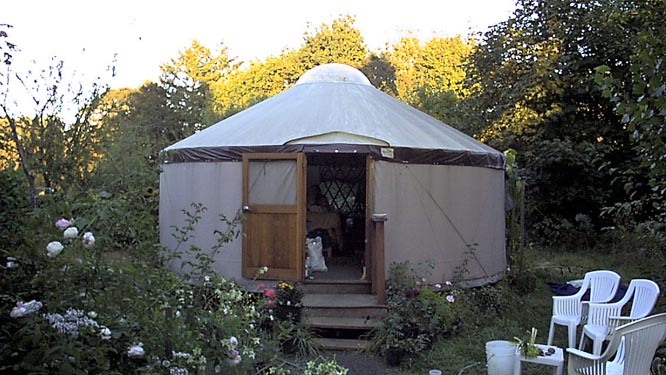
I arrived at the farm happy for the snowboot decision. The "office" is about a quarter mile uphill on a very snowy (not drivable) road, smack in the middle of the 20 acres of developed farmland. The office is in a yurt. Thankfully, a yurt with a rather large and well stoked wood stove. Inside, I met the farm co-owner Tom, who was wearing a pair of busted up work carharts and a Grateful Dead T-shirt over longjohns. All of my misgivings about the frayed sweater were immediately dismissed.

The interview went well (as well as a follow up phone-interview with another farm employee.) My favorite question - one I doubt comes up in most interviews - was "If you could be a vegetable, what vegetable would you be?" (Sorrel. Looks like plain old lettuce ... but bite into it and you get a lot more flavor than you bargained for!) The rest of the interview questions were predictable: What teaching experience do you have? What large-group-of-unruly-kid-herding experience do you have? What ages have you worked with?Organizational experience? Programs facilitated? Ad Nauseum. Regular interview stuff. But it was a very relaxed experience (lulled, no doubt, by the roaring wood stove.)

I know I made the first cut, but I haven't heard back about the final decision yet. I have my fingers crossed both ways. The job is pretty huge - they run a lot of field trips for a lot of kids throughout the farm season, and are expanding - which is (I hope) understandably overwhelming. Especially since I haven't had a 'real job' (does this even count as a real job?) in over a year. But it is also exactly what I am excited about; it is experiential, hands on learning that brings the community - kids and adults - into a closer relationship with the land they live on and the food that feeds them, ultimately with themselves.

More than anything, the process of thinking through and applying for this position has solidified the kind of education I want to be involved with in the future. I know that for all the slogging I am doing at the moment to get through the MS degree, this kind of thing is what I am doing it for. Focusing on this possibility (even if it doesn't turn out) has given me a lot more focus to keep slogging.

So I am waiting for that phone call.

1.17.2007

tag

Amba over at Ambivablog tagged me last week. Its my first tag as a Blogger, and I got that rush she wrote about, first felt playing tagging elementary school games. Since Solstice, we’ve been traveling and now, ramping up with a new semester’s course load, I’m starting to get back into the rhythm that allows time for at least sporadic blogging. This tag is a great one, though. I’m happy to (belatedly) throw in and pass it on.

1) Name a book that you want to share so much that you keep giving away copies.

The Sweet Everlasting by Judson Mitcham. I started this book one evening after supper and came to at four am, heart racing, reading and re-reading the last pages. I never did fall asleep. I gave the (borrowed) copy back and immediately ordered two for myself. I have managed to keep my hands on one. It is a beautifully woven story of growing up and being grown up in the old deep south, with all the scents and sounds and beauty of that landscape, and the brutality of it.

If they were easier to get hold of, I would give away copies of George MacDonald’s The Golden Key to everyone I spoke to. Unfortunately, the most accessible copies are abridged, and I have yet to find an in-print volume containing that single story. If you can get your hands on it, do. There is a link to the entire text on my sidebar, but I am loathe to recommend reading such a jewel on a glowing LCD. It needs a fireplace, hot chocolate, thick quilts. And most of all, it needs to be read aloud.

2) Name a piece of music that changed the way you listen to music.

My musical tastes aren’t very high-brow. In fact, I don’t really listen to all that much music. I never have. I was sheltered from everything except Beach Boys and Mannheim Steamroller Christmas growing up, and had very limiting obsession with CCM in early adolescence. My junior year, a friend lent me an Indigo Girls album. The Wood Song struck an angst ridden adolescent chord, and that lilting violin riff forever changed my understanding of what music was about, why people listen to it, make it, and how it can change them. It also gently nudged me into the understanding that secular music isn't actually evil.

3) Name a film you can watch again and again without fatigue.

I am a sucker for coming-of-age stories. Especially those of kids from the Western world learning about the rest of it far from their homeland. It doesn't take much to analyze that one. For a long time, “Empire of the Sun” was the only movie I would watch repeatedly. Since “Nowhere in Africa” came out in 2001, I have watched it at least six times.

4) Name a performer for whom you suspend all disbelief.

Daniel Day-Lewis. Christian Bale.

5) Name a work of art you’d like to live with.

There is a piece I saw in college, at the Art Institute of Chicago, that I wish I had now. It was an installation of waves, photographs of waves, all monotone with the ripples reflecting the faces of the viewers, almost moving in the glass. I miss the ocean.

6) Name a work of fiction which has penetrated your real life.

I read Kingsolver's The Poisonwood Bible while on an airplane flying out to work for six months with street children back home in Jakarta, occasionally (and horrifyingly) alongside missionaries nearly as insane and insidious as those in the book. It threw those I had to deal with in sharp relief, while giving me a story to work from in my own explorations of, and eventual dive into, the world the street kids inhabited. A world so physically close to yet so very far from my own TCK upbringing, I needed that nudge to get in with both feet.

7) Name a punchline that always makes you laugh.

“So you’re saying I’m fat?!?”

Well, it’s not exactly a punch line. But enough of a long-running college joke that we’re still using it, and laughing, years later.

I’m just going to tag the two regular readers I have, who I know have blogs themselves. Mama Hen over at At A Hen’s Pace, and Dan. Oh, Dan. I am so not saying you're fat!